


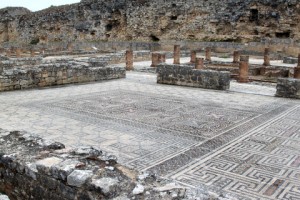
 Conímbriga established itself as one of the biggest complex of Roman ruins in Portugal, located near the village of Condeixa-a-Nova, having been equally an old population cluster of the Neolithic, inhabited during the Iron Age, before being conquered and Romanized, on the 1St century B. C.
The material remains found in the archaeological station proves its pre-Roman origin, as well as the Celtic presence, confirmed by the origin of its Celta Toponym, that means “high place and rocky” and “Fortified place.”
The urban aggregate of Conímbriga integrated the administrative circumscription of the Lusitania, which was located between the Douro and the Guadiana rivers, and that included approximately all the Portuguese territory, at south of the Douro River and the Spanish Extremadura and part of the province of Salamanca, where lived the Lusitanian people, since the Neolithic. Conímbriga was at the center of the road that connected Bracara Augusta (Braga) to Olisipo (Lisboa).
When the Romans arrived to this region, in the second half of the century I BC, Conímbriga was a flourishing village. Due to the peace established in Lusitania, it took a rapid Romanization of the local population, having been made Conímbriga in a developed and prosperous city, with beautiful houses, public baths and a Forum during the Roman occupation.
However, later in the wake of the administrative and politic crisis occurred on the Roman Empire, Conímbriga suffered the consequences of the barbarian invasions, having in 465 and in 468 the Suevi captured and looted partially the city, taking that was progressively abandoned.
After a long period of time, having been forgotten, Conímbriga returned to “reappear” in the late 19th century, due to the archaeological investigation carried out.
The Roman ruins of Conímbriga are known by their houses, gardens and polychrome mosaics, besides the wall of big dimensions, of its thermal baths and the remains of its forum. There are also the city walls, the mosaics, extraordinary examples of modern fluvial systems, the thermal baths, as well as several buildings.
In the ruins of Conímbriga, there is also the Amphitheatre, which is not visible to the visitors, having been a great public monument, destroyed at the end of the third century or beginning of the 4th century, when it was built the wall down-imperial, for which served as source of materials.
The building of the amphitheater, with a the dimension of 90 x 60 meters and with the capacity to accommodate more than four thousand spectators, was built in the late Julio-Claudian dynasty of the Roman Empire, taking advantage of a natural canyon that surrounded the city in the north. It is one of the monuments in better condition, since that all the entire lower floor was preserved under the rubble of the demolition. Currently, it is the target of a research project and of valorization.
Associated to Conímbriga, there is the Conimbriga Monographic Museum, created in 1962 and located in the vicinity of the ruins, which as objective to protect the respective ruins, to promote its exposition to the public and proceed to the respective archaeological investigation, being its heap composed exclusively by the archaeological materials collected in the city.
Conímbriga corresponds presently to an area consecrated as a national monument, defined by decree-law, in 1910.


