


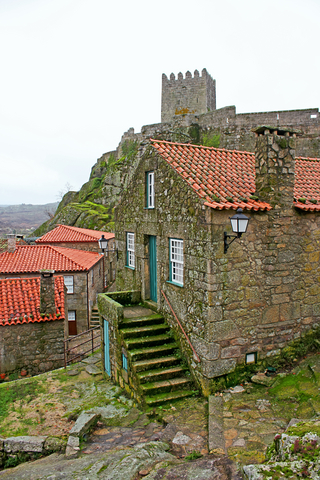
 Located at 760 meters high, at the municipality of Sabugal, it is considered one of the oldest and best preserved villages of Portugal, in a region of granitic lands and rugged relief. The historic village of Sortelha presents a medieval architectural set.
Its structure it is of a village with granite houses, narrow streets and alleys, enclosed by a fence walls and observed by a century castle of the XIII Century, which line remained intact during the last five hundred years.
All it constructions, houses, churches, the castle and the defensive fence, had as base, the granite, passing by the narrow streets paved, ripped on the rock, in permanent unevenness, being that all the povoation, is surrounded by a medieval wall .
Are identified in Sortelha, traces of human presence in the region, that ascend to the Pre-history, settlements from the Late Bronze Age, (1300-700 BC), vestiges of the Iron Age, as well as materials from the Roman ocupation.
The occupation of Sortelha, occurred in 1181, with the King Sancho I, “the settler” and in 1228, the King Sancho II, awarded him the first charter, which was later reconfirmed by D. Dinis. Dom Sancho II, promoted the construction of the Castle of Sortelha, which had at the time, a function of defense of the village and of defense of the border with the Kingdom of Castile, which stood on the Côa river.
With the confirmation of the charter granted by D. Dinis and with the reforms and enlargement that were made on the Castle, Sortelha gained some projection in the region. However, with the signing of the Treaty of Alcanizes, in 1297, between Portugal and Castile, which restored peace and set the borders between the two kingdoms, Sortelha is now more than 50 km away from the border.´
With this redefinition of boundaries, Sortelha lost its strategic importance. Later, in 1510, the King D. Manuel, has spurred a new restoration movement, giving it a new charter, with the objective to promote its resettlement and economic development.
Later, Dom João II, raised the medieval village to county in favor of Luis da Silveira, Guard chief of the King, whose body rests on the Church of Gois, in a tomb of the Renaissance. In 1617, the county was extinguished.
The wall and the castle became to be rebuilt again during the War of Restoration, between 1640 and 1648. In 1855, the county was extinguished, passing for the village of Sabugal. In 1910, its Castle, was considered as a National Monument.


